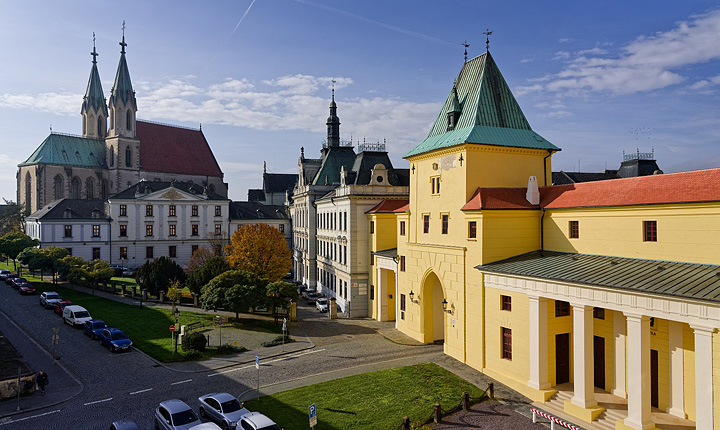
This website is dedicated to the collection of the most important Kroměříž monuments - the Archbishop's Castle, the Castle Garden and the Flower Garden, which were added to the UNESCO World Cultural and Natural Heritage List in 1998. This elevation to the World Cultural Heritage List recognised the uniqueness of this estate and made it part of the world heritage that inspires and obliges.
The Decree on Registration received by the Czech Republic states:
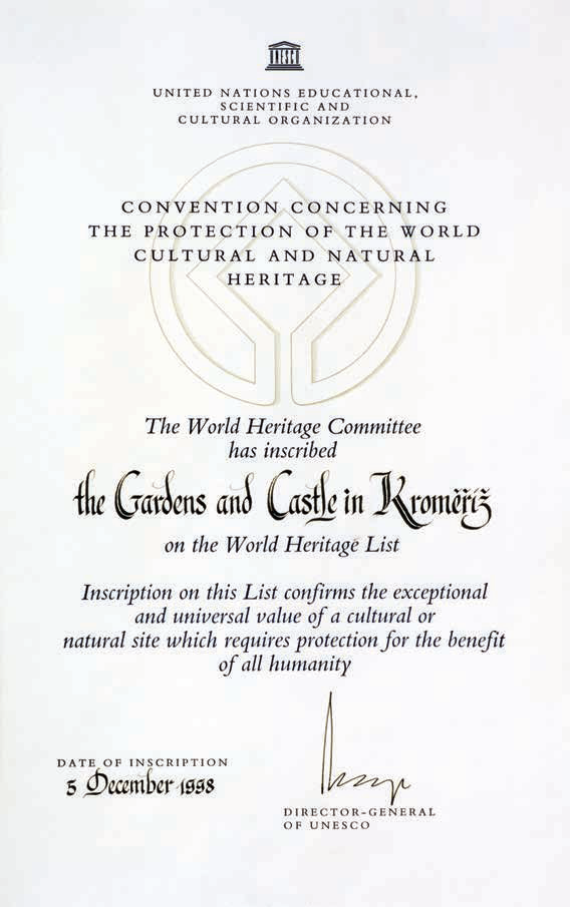
Decree on the inscription of the Gardens and Castle
in Kroměříž on the World Heritage List
“The World Heritage Committee has inscribed the Gardens and Castle of Kromeriz on the World Heritage List.
The inscription on this List confirms the exceptional and universal value of the cultural and natural property which requires protection for the benefit of all humanity.
Date of inscription
5 December 1998
Director-General of UNESCO, Federico Mayor”
The history of the property’s inscription on the World Heritage List was not an easy one. It is linked to the founding of the UNESCO Club Kroměříž in 1991 and to the people who became inspired by this idea and worked for it.
“The idea of inscribing Kroměříž on the World Heritage List was a child of the local civic initiative in Kroměříž; it was not born in ministerial corridors nor in scientific institutes.” The author of this recollection is Mgr. Michal Beneš, one of the experts who contributed to the inscription. The full text describing the course of the inscription and its historical context is here.
Mgr. Petr Pálka zpracoval historii zápisu zejména z hlediska místních aktivit a velmi přesného postupu jednotlivých aktérů. “The proposal for the inscription on the UNESCO World Cultural and Natural Heritage List was prepared in 1996–1997.” full text here.
Both authors are specialists and at the same time witnesses of the events in which they took significant part and which they describe. Their texts are a unique record of the entire process, from the original idea to the inscription of the Gardens and Castle on the World Heritage List. They are published with the authors’ kind permission.
Background materials and comparative study, Ministry of Culture of the Czech Republic, 1997. Digitisation was carried out by the District Archive in Kroměříž, April 2026. Here.
The World Heritage List is compiled on the basis of the Convention Concerning the Protection of the World Cultural and Natural Heritage (the Convention). Responsibility for implementing the Convention and its operational guidelines rests with the States that have acceded to it, including the Czech Republic.
The protection, preservation, presentation and transfer of this World Heritage monument to future generations, as required by the Convention, is the responsibility of the owners, but also of the state, public administration and all those who care about its future. This shared responsibility is expressed in the structure of actors involved in the implementation of the World Heritage Convention in the Czech Republic. Therefore, the Gardens and Castle in Kroměříž have their own management plan, Steering Group and site manager. management plan, Steering Group and site manager.
Detailed information on World Heritage monuments in the Czech Republic and their protection in the context of the Convention is described in the NPÚ publication: World Heritage and the Czech Republic.
- Brno
- Český Krumlov
- Holašovice
- Jizera Mountains Beech Forests
- Kladruby nad Labem
- Kroměříž
- Ore Mountain Mining Region
- Kutná Hora
- Spa Triangle
(Karlovy Vary, Františkovy Lázně, Mariánské Lázně) - Lednice-Valtice Cultural Landscape
- Litomyšl
- Olomouc
- Prague
- Telč
- Třebíč
- Žatec and the Landscape of Saaz Hops
- Žďár nad Sázavou
Archbishop's Castle
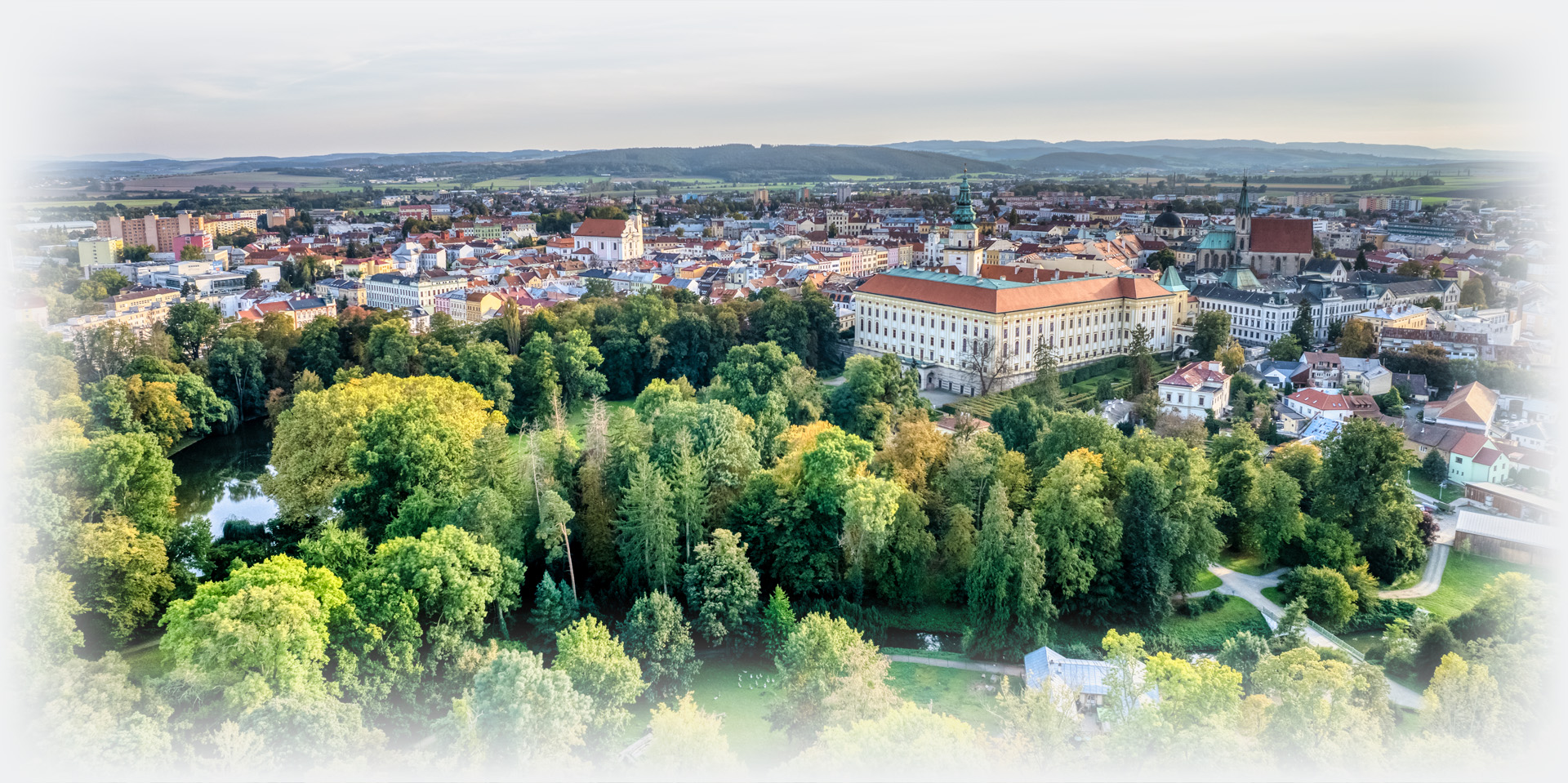
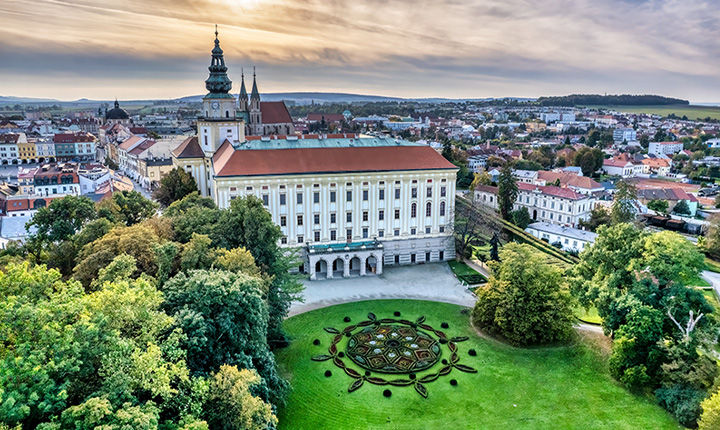
Kroměříž Castle, originally a bishop's residence founded in the 13th century, has undergone centuries of change from a Gothic residence to a Renaissance castle to a representative Baroque residence. It experienced its greatest heyday under Bishop Karl von Lichtenstein-Castelcorn in the second half of the 17th century, when, after the destruction of the Thirty Years' War, it was rebuilt according to the plans of Filiberto Luchese and Giovanni Pietro Tencalla. The Castle is a UNESCO World Heritage Site and is one of the most important historical buildings in Moravia.
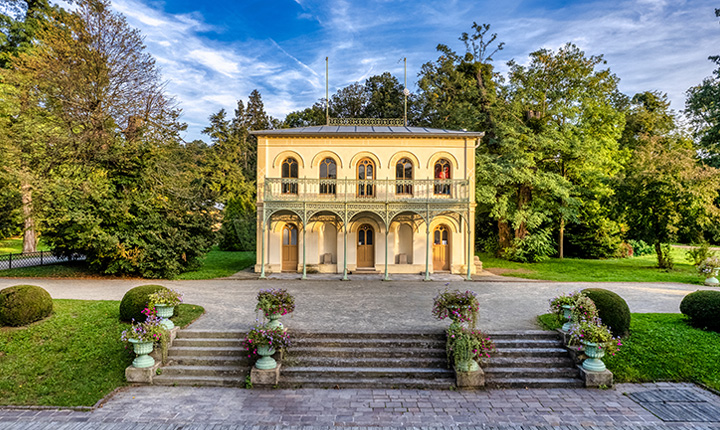
Castle Garden
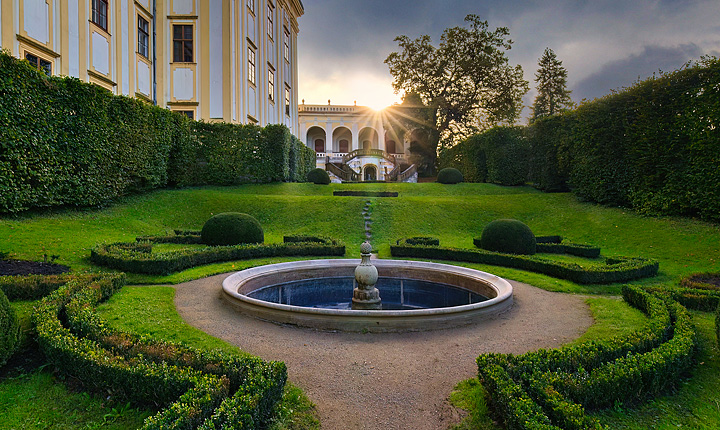
The Castle Garden in Kroměříž was built during the Renaissance for the needs of the bishops of Olomouc and later archbishops. It underwent a number of modifications in line with the architectural styles of the time. It was not until the mid-19th century that it reached its peak in terms of landscape composition and size, covering more than 60 hectares. Today, visitors can admire a number of garden structures, artistic elements, a wealth of valuable trees, flowering meadows, water features, and animals.
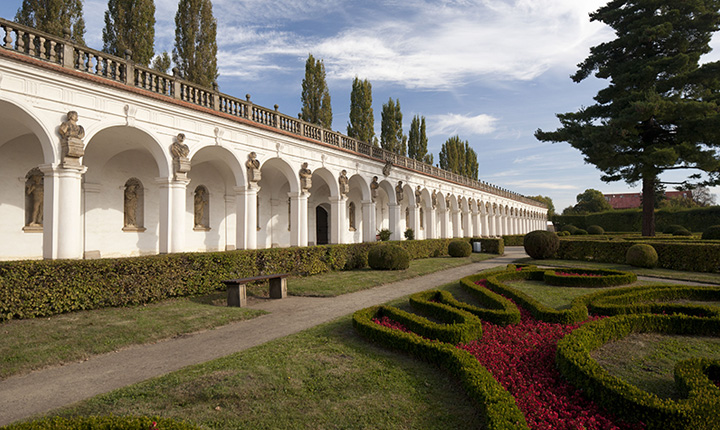
Flower Garden
In 1664, Bishop Charles II of Liechtenstein-Castelcorn arrived in Kroměříž, which had been ravaged by the Thirty Years' War, and built not only a representative castle residence, but also a remarkable early Baroque garden richly decorated with buildings and divided by high shaped walls. Thanks to a fortunate coincidence and careful restoration, it is now possible to admire the Dutch Garden, Trout Ponds, Rabbit Hill, and many other attractions.
Kroměříž Castle and Art Collections
The Archbishop's Castle in Kroměříž is one of the most remarkable monuments of its kind in Central Europe. Its beauty and significance do not lie only in its monumental architecture or picturesque setting in the urban landscape defined by the Castle Garden and the Flower Garden, but above all in its unusually strong continuity: for centuries it was the seat of the Olomouc bishops and archbishops, the administrative center of a vast estate, a place for political negotiations and cultural representation. This long functional continuity has meant that the local architecture, interiors and collections have been preserved in a form that is unparalleled in the region. The development of the castle begins in the High Middle Ages, when Kroměříž became the permanent possession of the Olomouc bishops. It continues with Renaissance reconstruction, culminating in the monumental Baroque work of Bishop Karl of Lichtenstein-Castelcorn and his artists, to be supplemented with modern modifications in the 18th and 19th centuries and later sensitively restored. The castle is also home to extraordinary collections that, in their scope and quality, transcend the borders of the country: a picture gallery with works by old masters, a library with thousands of volumes, a music archive with unique sources of European significance, a collection of drawings and graphics, and a numismatic collection form an interconnected whole that reflects the cultural ambitions and collecting passions of the resident bishops and archbishops.
The foundations of the castle date back to the Middle Ages.
Although older research has long linked the establishment of the local residence with the 12th or 13th century, when Kroměříž became the property of the bishopric, convincing construction documents of the fortified settlement come mainly from the 15th century. At that time, Bishop Jan Železný began construction work in the city, which gave the current site near the main town square the character of a small castle. Although previous tradition spoke of „Brun's Castle“, more recent research shows that the early medieval manor probably did not stand on the site of today's castle. The real contours were only acquired in the late Gothic reconstruction associated with the personality of Bishop Stanislav Thurz. After 1500, he invested significantly in his Moravian residence and gave it the form of a representative castle with a distinctive tower. It is this tower, now decorated in Baroque style, that is the oldest preserved element of the castle and structurally forms its core. Fragments of late Gothic masonry and basements still remain in its surroundings, which demonstrate the continuity of the building across six centuries.
The sixteenth century marked the gradual transformation of Kroměříž from a medieval castle into a Renaissance castle.
Thurz's construction work was continued by his successors Marek Khuen, Vilém Prusinovský and Jan Mezon. However, the most significant role was played by Bishop Stanislav Pavlovský. During his time, extensive renovations were carried out to the living spaces, new halls were built, windows and portals were unified and, above all, representative rooms were built on the first floor. The gardens were also transformed - a „new garden“ was created north of the castle, the predecessor of today's Castle garden. The tower was given a double-shell Renaissance helmet, which was a significant symbol of episcopal power. Woodcuts from the end of the 16th century show a four-winged complex with corner turrets, a courtyard and a monumental southern tower with a high roof. Renaissance builders here managed to combine the late Gothic core with contemporary aesthetic requirements, creating an impressive, albeit still irregular, whole.
The second half of the seventeenth century was a period of greatest architectural and artistic development.
The Thirty Years' War brought a dramatic turning point. In 1643, Kroměříž was conquered by Swedish troops, the city and the castle were plundered and severely damaged. Temporary repairs did not save the situation, and in 1656, the castle was hit by a fire that destroyed the roofs and trusses and damaged the vaults in the upper floors. The condition of the residence was so critical that the Manx court even moved, which proves the uninhabitability of the building. At that time, the imperative of its fundamental renovation arose, which was fully fulfilled by Bishop Charles of Lichtenstein-Castelcorn, one of the most important figures in the history of Moravia. His accession to the episcopal see in 1664 opened the way for the largest construction project in Kroměříž, which gave rise to one of the purest and most monumental Baroque residences in the lands of the Bohemian Crown.
The first phase of the restoration, led by architect Filiberto Luchese, was more of a stabilization phase. Luchese consolidated the torso of the Renaissance building, modified the vaults, roofed the courtyards and prepared the grounds for a major reconstruction. However, the decisive phase was the construction phase carried out after 1686. Its architect was Giovanni Pietro Tencalla, an artist with excellent experience from the Habsburg court in Vienna. It was he who gave the castle a new form of a four-winged building around an enclosed courtyard. However, he did not demolish all the older structures: his key choice was to preserve the central tower as a symbol of the residence, but at the same time to give it a new Baroque extension with a helm. Tencalla designed the building with representation in mind – the residence was to be a demonstration of episcopal power, education and cultural ambitions at the time of the re-Catholicization effort. The castle therefore acquired magnificent halls, a monumental staircase, a well-thought-out connection with the Baroque castle garden and, above all, a unique sala terrena, a space connecting not only the interior with the exterior, but also symbolically the earthly and heavenly spheres.
The Sala terrena is the pinnacle of Baroque decoration. The ceiling frescoes by Paolo Pagani, original illusory painting with dramatic abbreviations and light contrasts, complemented the rich stuccoes by Baldassarre Fontana. Here, the sculptor demonstrated a modern Roman concept of stucco work: dynamic frames, plastic figures, decorative elements and monumental architectural divisions – all together creating a space that feels like a living theater stage. The Sala terrena was not just an ornamental room – it served for informal representation and entertainment. It is a space that is still one of the best examples of Baroque illusory decoration in the country. Equally important is the main staircase – the functional backbone of the entire castle. It leads the visitor under the statues of mythological figures and allegories to the representative halls on the first floor. It was here that the key rooms for receiving guests, meetings and celebrations were located. Tencallo's construction progressed rapidly: in less than twelve years, most of the northeast and southeast wings were built, the great hall, staircase, kitchen were vaulted, the Sala terrena was completed, and work began on the other wings. Foreign and local craftsmen often worked on the building in the dozens at the same time.
In the eighteenth and nineteenth centuries, the castle was used and maintained by the Olomouc archbishops.
After the death of Charles of Lichtenstein-Castelcorn, his successors continued to complete the interiors. However, a major intervention was brought about by the fire of 1752. It destroyed the trusses, roofs, upper floors and severely damaged the tower. Under the leadership of the architect Ignác Josef Cyrani of Bolleshaus and later Jan Antonín Křoupal, the roofs were restored, the tower rebuilt and the interiors were modified. Křoupal designed a new copper helmet with a lantern, which became the characteristic feature of the castle for the next century. The repairs also brought a new Baroque chapel of St. Sebastian and the modernisation of the library and living spaces. In the 19th century, the castle acquired some classicizing accessories and modern technical facilities. More significant than the construction interventions themselves at this time is the fact that the residence remained permanently in use by the archbishops, which contributed to the preservation of the furnishings, collections and library in an unusually compact form.
In the 20th century, the Kroměříž Castle underwent significant changes, which were mainly related to changes in ownership, monument care and gradual opening to the public.
After 1918, the residence remained in the possession of the Olomouc Archbishopric, but its use gradually changed and some parts were adapted for administrative purposes. The castle and its collections survived the Second World War with only minor damage. After 1948, the communist regime nationalized the castle and its collections. The buildings came under state administration and later extensive restoration work was started on the facades, interiors and gardens. In the 1970s and 1980s, significant repairs were carried out, which, paradoxically, are not sufficiently documented. After 1989, the castle became part of an open cultural and heritage policy, in 1998 it was inscribed on the UNESCO World Heritage List together with the Flower Garden and the Castle Garden, and gradually transformed into an institution that combines historical architecture, archbishopric collections and modern museum presentation. The harsh conditions of the communist regime were rehabilitated in 1994, when the art collections were returned to the Olomouc Archbishopric, and in 2018, when the castle with the Castle Garden was returned.
An integral part of the history of the castle are its art collections.
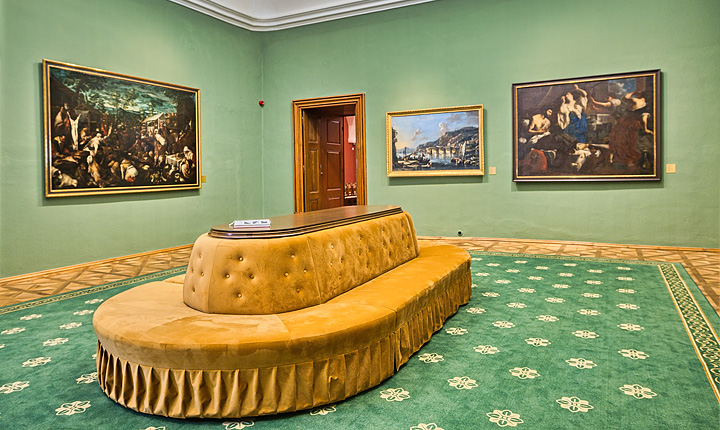
The pictorial collection is one of the most important private collections in Central Europe and its foundation was laid again by Bishop Charles of Liechtenstein-Castelcorn. His collection-building strategy was exceptionally modern for his time and in the context of Central Europe: he employed court painters and copyists, had exact copies of works from the imperial picture gallery in Vienna made, purchased through agents in European centers and at the same time acquired entire private cabinets. The most significant achievement was the purchase of the extensive collection of the brothers Franz and Bernhardt von Imstenraedt in 1673, which contained important works from leading European collections, including paintings from the famous collection of the English King Charles I and the great art connoisseur Thomas Howard, Earl of Arundel. Among them, Titian's suggestive late painting Apollo and Marsyas or the famous portrait of the English royal couple by Anthony van Dyck stand out - today one of the most valuable paintings in Czech public collections. Extraordinary works of Italian, Dutch, German and Central European painting from the 15th to 17th centuries thus reached Kroměříž: works by Lucas Cranach the Elder, Pieter Coeck van Aalst, Hans von Aachen, Quinten Massijs, Lucas Gassel, Frans Floris, Pieter Brueghel the Elder, Veronese, Carracci, Bassano and other top painters. The inventory from 1691 lists more than 750 paintings distributed between Olomouc and Kroměříž. Although the collection was partially reduced in the 19th century, especially by the auction of 1830, it has been preserved in a surprisingly compact form as a set of almost 600 paintings, which has retained its original profile and character of the 17th century. In addition, the castle houses a rare collection of 67 Renaissance and Baroque drawings and almost twenty thousand graphic sheets, representing another layer of exceptional artistic heritage that makes the Kroměříž archbishop's collections one of the most valuable art collections in Central Europe.
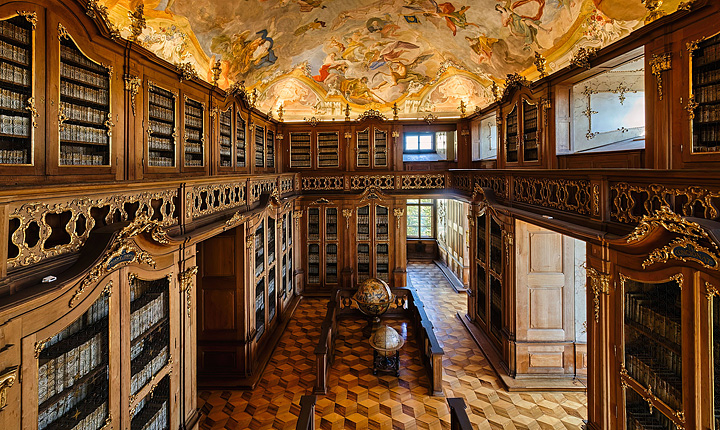
Equally unique is the library, founded in 1694. It contains more than sixty thousand manuscripts, early prints and books in various fields – theology, history, philosophy, natural sciences, law, architecture and art. Bishop Karel included his own collection in it, as well as forbidden books (libri prohibiti), which complement its character as a scientific cabinet of the late Baroque world. The music archive is another treasure of the castle: it contains compositions by Heinrich Biber, Pavel Josef Vejvanovský and other authors of the 17th and 18th centuries, unique scores and autographs, which make Kroměříž one of the most important centers of the study of Baroque music in Central Europe. The mosaic of spiritual and cultural representation is then complemented by a numismatic collection, particularly rich in coins of spiritual representatives of early modern political power.
The Olomouc Museum of Art, a state-funded organization, was entrusted with the management of the valuable archbishop's collections at the beginning of the third millennium.
The museum participates in the management of the castle and the collections, emphasizing the connection of all components of the artistic heritage. Thanks to a unique and mutually beneficial agreement, the castle is now not only a monument, but also a living museum, in which the visitor not only discovers Baroque architecture in its authentic form, but also walks through the picture gallery, library and several collection cabinets. By visiting the residence, the Castle Gardens and the Flower Gardens, he enters a unique complex inscribed on the UNESCO World Heritage List, which is exceptional precisely because of its extraordinary integrity: the architecture, gardens, collections, urban structure and historical function create a unity here that is rarely found elsewhere.
Kroměříž Castle is thus not only an architectural monument, but also a living testimony to the cultural, political and spiritual history of Moravia. It was not created just as a representative palace, but as a complex organism in which the power ambitions of bishops, top art, European collecting and thoughtful landscape design meet from the Middle Ages to the present. This unique combination makes Kroměříž Castle one of the most important places of cultural memory in the Czech Republic.
Author: Mgr. Miroslav Kindl, Ph.D
Castle Garden
The beginnings of the history of the Castle Garden can be traced back to the Renaissance period. This garden was seriously damaged during the Thirty Years' War and was restored in the early Baroque spirit during the episcopate of Bishop Charles II of Lichtenstein-Castelkorn (1664–1695). The formal composition gradually changed during the 18th century according to the development of Baroque thought. The first Archbishop of Olomouc, Antonín Theodor Colloredo-Waldsee (1777–1811), under the influence of Enlightenment ideas, expanded the garden between 1790 and 1800 and transformed it into a sentimental composition. In the 1830s, Archbishop Ferdinand Maria Chotek (1832–1836) came to Kroměříž and, together with the architect Anton Arche (1793–1851), began a radical transformation of the Castle Garden into a generous landscape park. After Chotek's death, the project was implemented by his successor, Archbishop Maxmilián Sommerau-Beckh (1837–1853). During this period, the garden experienced its greatest flourishing and acquired its current area of more than 60 hectares. In the second half of the 19th century, the composition of the garden was enriched with a number of other small buildings, flower beds and a collection of trees. Since the beginning of the 19th century, the Castle Garden has been open to the general public and since its second half it has also been lent out for residents to enjoy sports, e.g. ice skating, boat rides or group exercises. Even today, it is practically the only large green area in the city of Kroměříž.
The beginnings of the history of the garden – Renaissance garden
The oldest garden at the castle in Kroměříž was most likely established in the first quarter of the 16th century under the Olomouc bishop Stanislav Thurzo (1496–1540). It was created in connection with the construction of the bishop's residence on a plateau above the floodplain of the Morava river. The garden was established in the wold and was separated from the castle building by a terrain fault and a massive moat. From the castle building, one could descend to the garden over a bridge that spanned a massive defensive moat. This was used for breeding fallow deer, whose observation from the windows of the castle provided a pleasant distraction. It was a purely private garden intended for the bishop's residence inhabitants and also the garden had a significant production function. It supplied the Kroměříž and Olomouc bishop's courts with fruit and vegetables.
1566 the first written reports about the Kroměříž garden from the time of Bishop Vilém Prusinovský of Víckov (1565–1572), who wrote in 1566 to Wolfgang of Liechtenstein in Mikulov: “Here near Kroměříž we will have a new garden built for us, in which we need quite a few roses for planting. And since we cannot order them anywhere around us as much as we need, we have understood that you should have quite a few of them near Lednice. Therefore, we ask you to give us as many of the young roses as possible for such a need, which would be suitable for planting.”
1588 “the burghers’ pigs got into the garden and did a lot of damage, tearing everything up, when the seeds had already been sown”. In response to this event, Bishop Stanislav II. Pavlovský (1579–1588) enclosed the garden with a new wooden fence and in May sent the gardener Peter to Litomyšl “for some flower seeds and other gardening things for our new garden here”.
1596 Papal legate Enrico Caetani, who visited Kroměříž in July 1596, wrote that he spent time in “a beautiful garden with excellent beds of various plants, artistically arranged to represent symbols, animals and various other patterns”.
1643 The town and the castle residence were occupied by the Swedish army, burned and devastated.
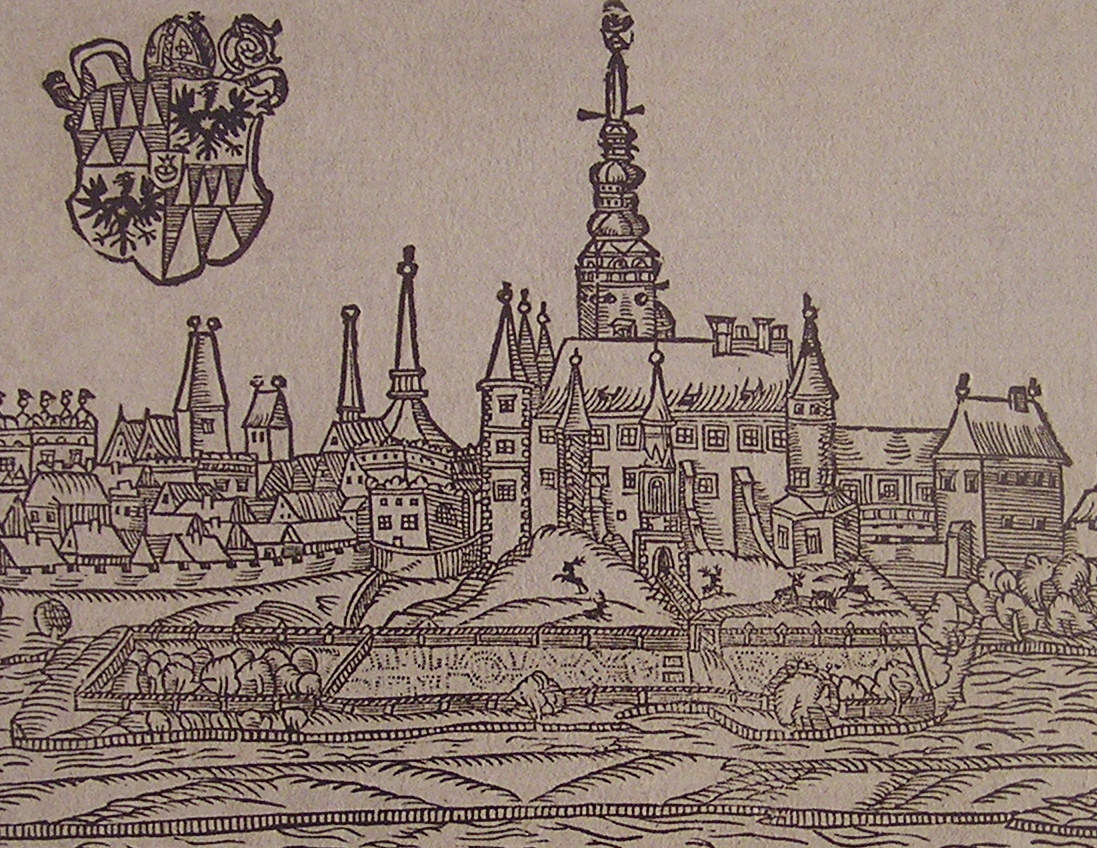
The castle with the Castle Garden, detail from a view of the city of Kroměříž from the end of the 16th century.
Baroque Garden
The town of Kroměříž was largely damaged during the Thirty Years' War. It flourished again thanks to Bishop Charles II of Lichtenstein-Castelkorn (Bishop 1664–1695). He had the castle building rebuilt, which had already descended from the river terrace to the river floodplain in its architecture. A new early Baroque garden was probably built on the area of the destroyed Renaissance garden. It was still separated from the castle by a moat, which, however, had more of an aesthetic function than a defensive one. The composition of the garden features a longitudinal axis passing through a formally designed parterre through a water canal to the orchard (with grafted trees) and the adjacent woodland vegetation. In the high Baroque phase, the water canal and the orchard disappeared, and are replaced by a formal arrangement culminating in a garden pavilion forming the architectural conclusion of the garden. A new kitchen garden was created next to the parterre.
1664 Bishop Charles II Liechtenstein – Castelcorn arrived.
1665 architect Filiberto Luchese prepared a project for the restoration of the castle and the adjacent garden. After his death in 1666, Giovanni Pietro Tencalla (1629–1702) continued to lead the work and prepared the design.
1691 in the graphic album of G. M. Vischer and J. van den Nypoort, engravings depicting the intended early Baroque form of the garden were published.
1722–1738 during the episcopate of Bishop Wolfgang Hannibal of Schrattenbach, the garden was newly decorated in Baroque style.
On June 14, 1748 Empress Maria Theresa arrived in Kroměříž and stayed there for four days. During her visit, it is said that everyone in the Empress's entourage was captivated by the splendour of Kroměříž Castle and gardens.
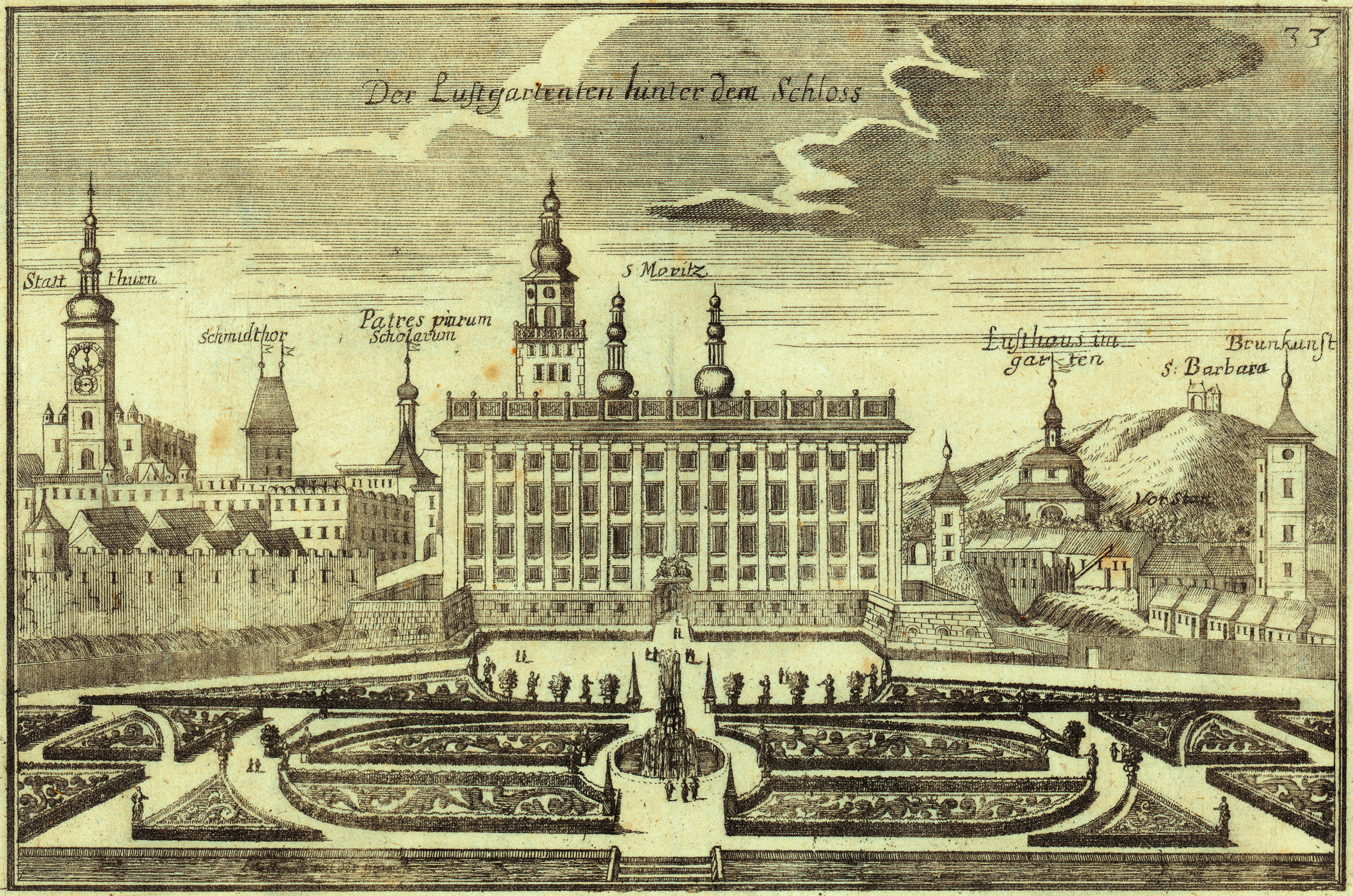
Depiction of the intended form of the Castle Garden on an engraving by Justus van den Nypoort from 1691. At the time of publication of the graphic album, the garden had not yet been founded.
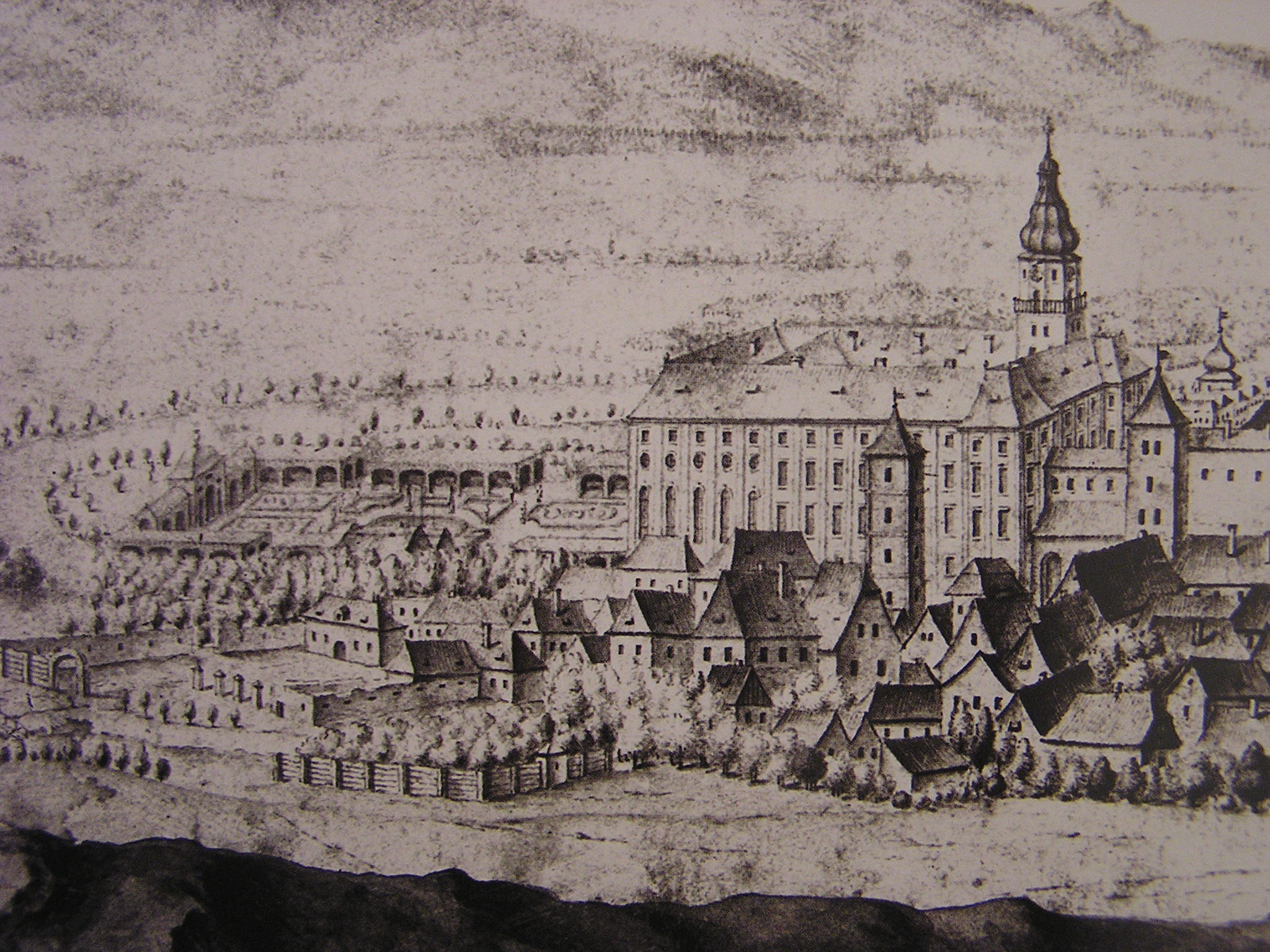
A castle with a Baroque-style garden in a drawing from the 1770s.
Sentimental garden
In 1777, the Bishopric of Olomouc was elevated to an Archbishopric, and the first Archbishop, Antonín Theodor Colloredo-Waldsee (1777–1811), initiated a radical transformation of the garden in a modern sentimental spirit. The formal composition of the parterre was simplified, which was followed by new sections divided by a regular grid of poplar rows into small spaces designed in an informal style. The newly established sentimental arrangement was equipped with a number of small garden buildings (artificial ruins, the Temple of Friendship, the Chinese Pavilion, the Tahitian Pavilion, a hermitage, a salon in a wood fence, etc.) and attractions. The park was further expanded with the Long Pond with the so-called Fisherman's Pavilion and a farmhouse with an orchard, which were already located behind the mill ditch. The addition of the so-called Colloredo Colonnade created another entrance to the garden from the castle building, and a new entrance to the garden behind the Mill Gate was also created for the city's residents.
1790–1800 extensive modifications of the Castle Garden were carried out in a sentimental spirit.
1802 an album of 19 copper engravings and two plans with a text part was published - Die fürstliche Gärten zu Kremsier, beschrieben von einem Freunde der verschönerten Natur, depicting individual parts of the newly modified garden. The author of the engravings was Josef Fischer.
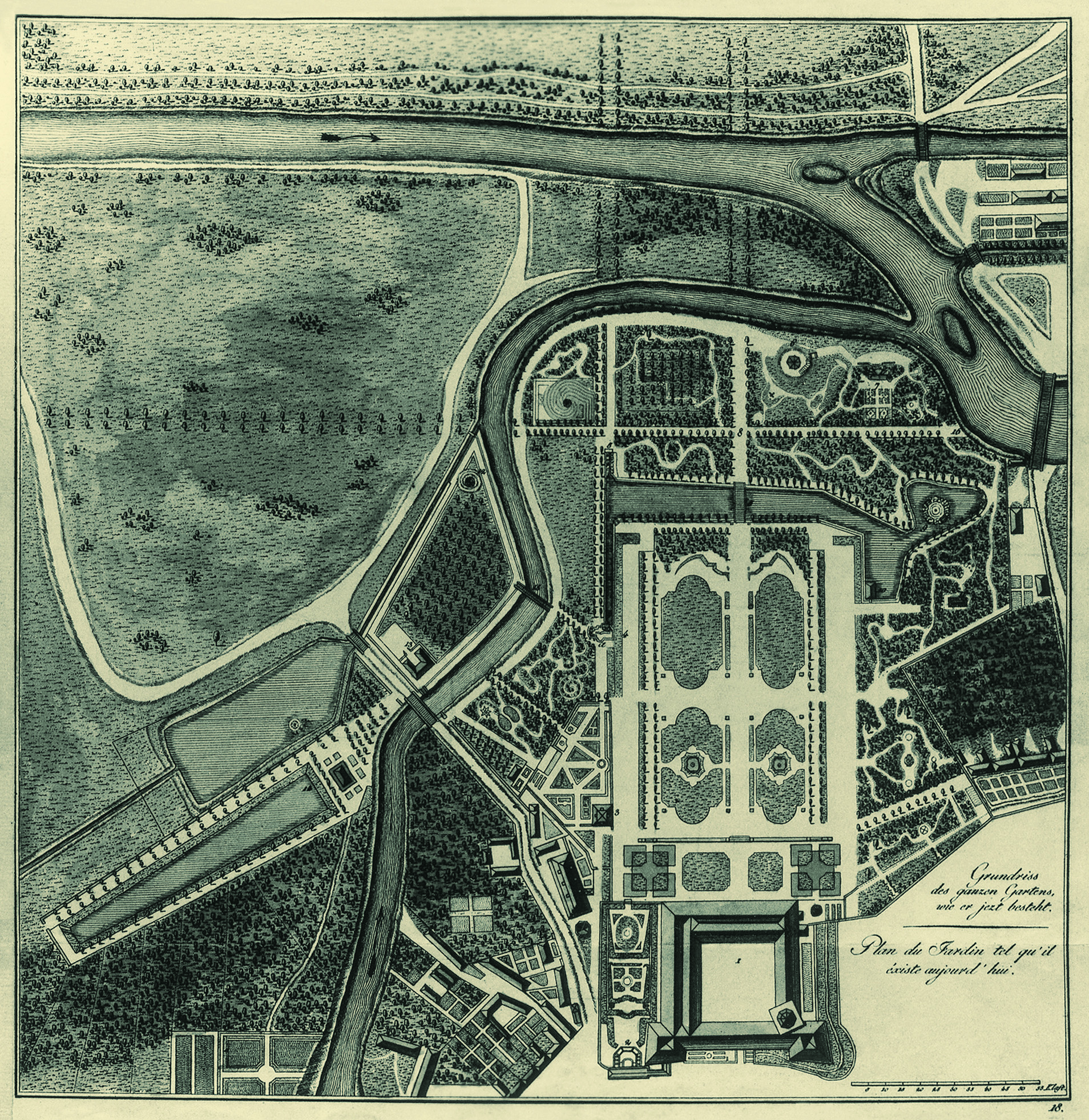
Overall plan of the Castle Garden after modification in a sentimental spirit, 1802.
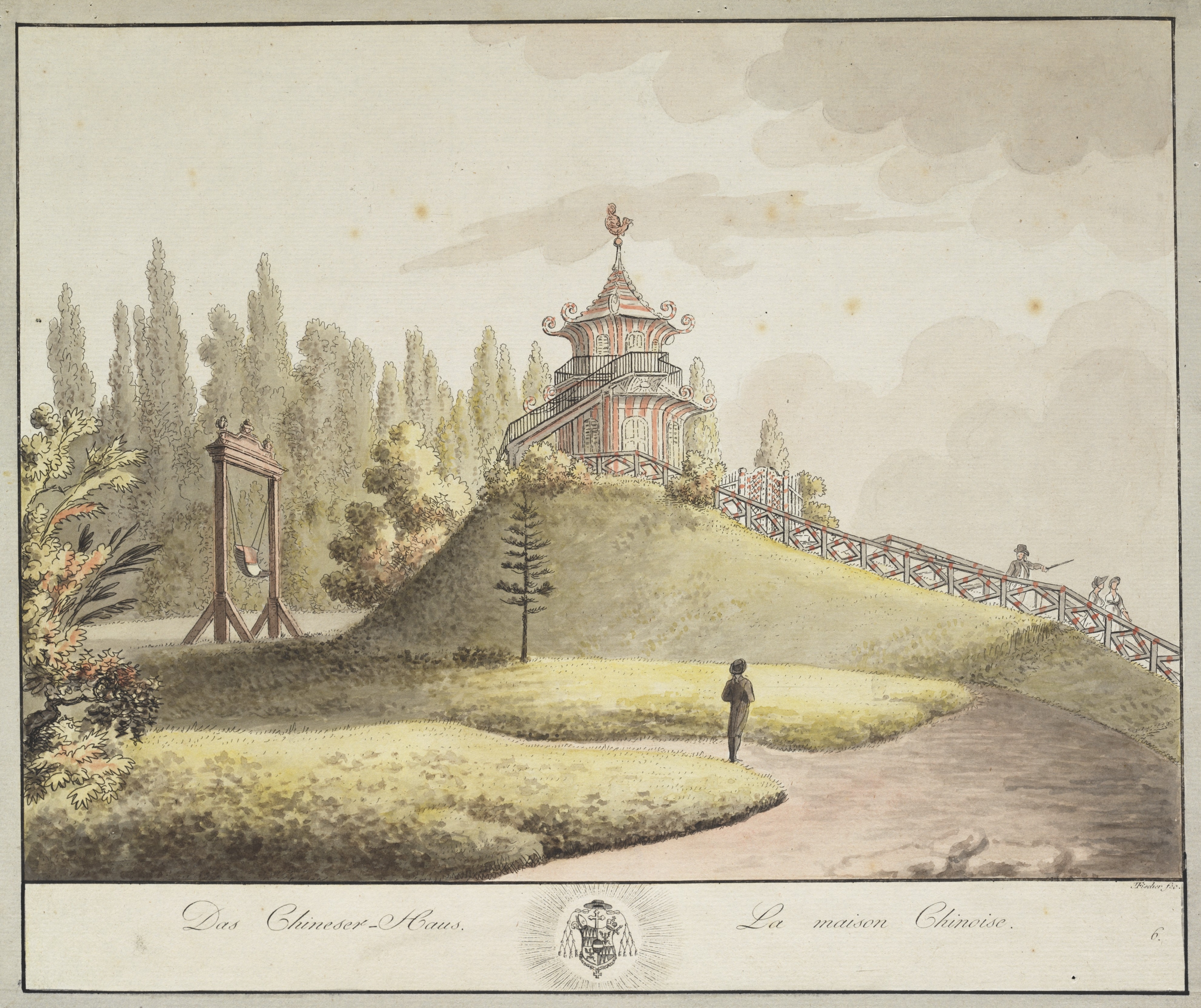
DThe now-defunct Chinese pavilion is depicted in an engraving from 1802.
Landscape garden
In 1832, Ferdinand Maria Chotek (1832–1836) became Archbishop of Olomouc, who invited the architect Anton Arche (1793–1851) to Kroměříž. Arche created a generous landscape garden with an architectural component in the Classicist style. This period is the peak of the artistic and historical development of the Castle Garden, even though these modifications almost erased all previous historical stages. The garden reached its largest area of 60 ha. It was equipped with a new architectural program. In addition to a series of new buildings (Colonnade, Silver Bridge, American Guardhouse, Max's Yard, Turkish and Gypsy Tents, Swan and Fantasy Pavilions, Mandarin House, etc.), some of the buildings from the previous sentimental period of the garden's development were also used. A generously scaled space was created with long visual axes focused on several significant buildings and trees. Extensive orchards and a model farm for breeding and presenting cattle also became part of the garden.
1834–1835 Anton Arche prepared a study of the modifications of the Castle Garden. The study dealt with the modifications of the older parts of the garden, delimited by the mill gutter.
1836 the areas of the city pastures called Hořenuše were purchased with the intention of expanding the area of the Castle Garden.
1836–1850 the new Archbishop Maxmilián Josef Sommerau-Beckh (1836–1853) continued the work of his predecessor and built a new garden behind the mill gutter.
1847 Vojta Náprstek wrote about the garden: “Right next to the castle there was a large castle garden, it is an English park and is said to be one of the most beautiful in the entire monarchy; there are fountains, ponds, caves, a Chinese gloriette, a waterfall, magnificent bridges, a pheasant house, a colonnade, garden houses, etc. The most memorable is the large building with decorated columns, which at first glance I took for a new school, but my guide told me that he had imagined it for several of the lord's cows and oxen.”
1850 Bernard Lipavský and Johann Hommeh created a plan for the new garden.
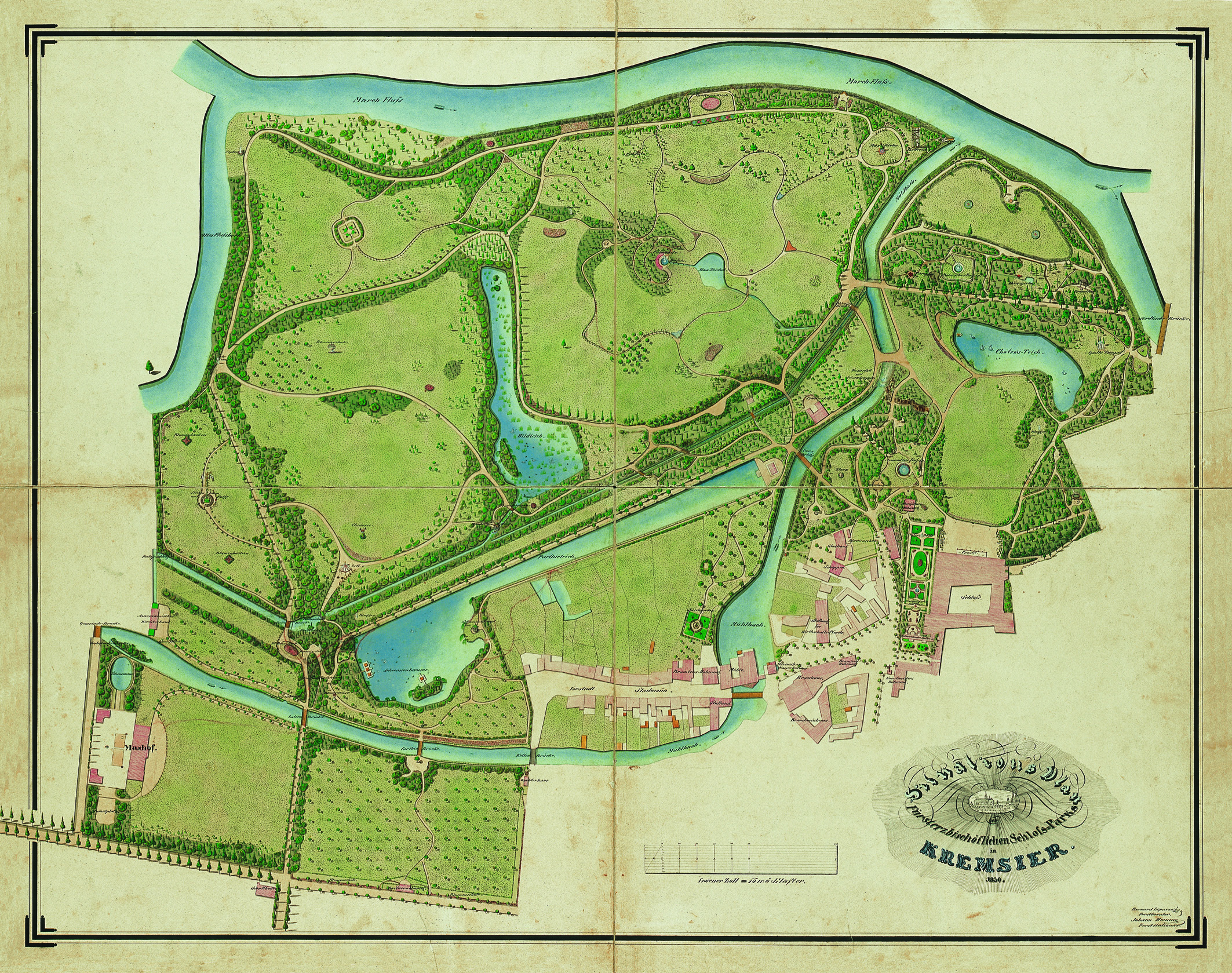
General plan of the Podzámecká Garden from 1850 by Bernard Lipavský and Johann Homme.
Eclectic Garden
In the second half of the 19th century, another wave of returns to historical themes occurred in garden art. From a rather restrained classicism, there was a transition to greater variety and diversity. This also applied to the appearance of buildings in gardens and parks. Objects reminiscent of various historical periods appeared here again, complemented by rich floral decorations and a number of exotic trees. Architects Ernst Králíček, Karel Biefel, František Drbal, Gustav Meretta and Anton Kybast participated in the modifications of the buildings in the Castle Garden. The hermitage, the Flower Tower, the Flagpole, the Swan Pavilion by the Long Pond, the Turkish tent, mechanical Chinese puppets and other small architectural elements gradually disappeared from the garden. On the contrary, the composition newly appeared Birch Pavilion which replaced the Flower Tower, the cast-iron trellis near the Silver Bridge, the Chinese Pavilion on the island, the construction of a water sawmill near the American Guardhouse, etc. These modifications were implemented during the episcopate of Archbishop Frederick of Fürstenberg (1853–1892) and Archbishop Theodor Kohn (1892–1904).
In 1883 a book was published on the assortment of trees grown in the Castle Garden - STRUSCHKA, H.: Die nennenswerten Dauergewächse des fürst-erzbischöflichen Schlossgartens in Kremsier.
In 1897 the archbishop's mill on the outskirts of Sladovna, with which the fountains in the garden were supplied with pressurized water, burned down.
Period 1900–1950
1907 the regulation of the Morava river began, which changed the shape of the garden and partly its composition.
1908 according to Holzbach's illustrated guide to Kroměříž and its surroundings, an entrance fee of 2 Hellers per person was charged to the garden, the entrances were open all year round except for the lunch break from 12–13 o'clock.
1906–1916 wells were built on the garden area to collect drinking water for the city.
1913–1914 conifers were planted in large quantities in the garden with the aim of establishing an arboretum here.
1914 Dr. Vl. Pavlák published the brochure Konifery K.-ARC. Of Castle Garden in Kroměříž at his own expense.
1914 Construction of a sports field began on the site of the filled-in section of the mill ditch and the deputy gardens (today's tennis courts and Bajda swimming pool).
1920s Part of the orchards adjacent to Kojetínská Street were closed and dedicated to the development of family houses.
1949 The Castle Garden became state property.
Period after 1950
The garden, as the only large park-like space in the city, is freely accessible and widely used for recreation. Max's Yard was separated from the Castle Garden, a veterinary clinic was established there and later facilities for stabling horses and professional training of high school students. A new water supply from the Morava river to the garden was built as a replacement for the filled-in mill gutter.
1958 the garden became a cultural monument.
1995 the garden became part of the National cultural monument “Kroměříž Castle with the Flower and Castle Gardens”, but without the Max's Yard area.
1997 the flood affected almost the entire area of the Castle Garden. 100 mature trees were directly destroyed and another 100 mature trees were so damaged that they had to be subsequently cut down.
1998 On 2 December 1998, the gardens with the castle in Kroměříž were inscribed on the UNESCO World Cultural and Natural Heritage List, including the Max's Yard area.
2008-2014 construction of a new horticultural facility as part of the National Centre for Garden Culture in Kroměříž (NCZK) project, co-financed by the European Union.
2011-2012 revitalization of the vegetation component of the garden composition (planting 320 trees, felling 270 trees) largely financed from the Operational Environmental Program.
2020 The Castle Garden was returned to the ownership of the Olomouc Archbishopric.
2020-2021 The garden's water system was revitalized.
Author: Ing. Lenka Křesadlová, Ph.D
Flower Garden
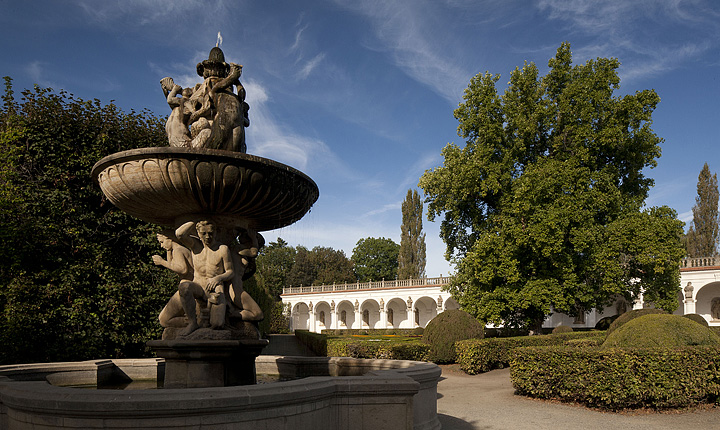
A flower garden, founded in the second half of the 17th century. Bishop Charles II of Lichtenstein-Castelkorn (bishop 1664–1695) came to Kroměříž, devastated by the Thirty Years' War, in 1664 and built not only a representative castle residence but also a garden according to contemporary models. Due to the lack of suitable areas near the castle building, the new garden was located outside the city walls in the orchard near the settlement of Štěchovice.
The imperial architect Filibert Luchese (1606–1666) began to create the garden plans. After his death, his colleague Giovanni Pietro Tencalla (1629–1702) took over and completed the task with the help of Antonín Martin of Lublinský (1636–1690) and, above all, Bishop Charles, who, thanks to his education and extensive library, had clear ideas about what his new garden should look like. The Kroměříž pleasure garden is composed as an axially symmetrical formal (regular) garden on a rectangular plan measuring 485 × 300 meters. It consists of two main parts – a flower bed with shaped walls and broderie (lacy) beds and a partition with Strawberry Hills. These main parts are complemented by a belt of small separate garden spaces intended for breeding animals and growing rare plants – the Orange Garden, the Dutch Garden, the farmyard, the pheasant house, the Rabbit Hill and the aviary or birdhouse. The entire garden was surrounded by a wall and was originally entered through a gate in the middle of the colonnade equipped with three decorative portals on the outside, only one of which framed the actual entrance to the garden. It included a bust of the garden's founder, Charles of Lichtenstein-Castelcorn, and a Latin quote: „Enter, pilgrim, and if you wish, behold the difficult transformation of this once marshy and uncultivated field. Happily and undisturbedly enjoy with pleasure the garden, which has been furnished with due care and considerable expense; it is built for you, also for us and descendants.“
The Flower Garden is the only preserved garden of this type. Other gardens founded in the same period disappeared or were gradually modified in a different artistic style. The Flower Garden escaped the same fate by being transformed over time into a kitchen garden forming the background for the gradually developing the Castle garden. The unique garden buildings and high shaped walls were maintained in their original form for centuries thanks to the respect of subsequent bishops and archbishops for the work of their predecessor and thanks to the awareness of the high artistic value of the garden complex. Since the second half of the 20th century, the garden has been gradually restored to the form it probably had at the time of its founding. The Flower Garden, together with the chateau and the Castle garden, was inscribed on the UNESCO List of World Cultural and Natural Heritage Sites in December 1998.
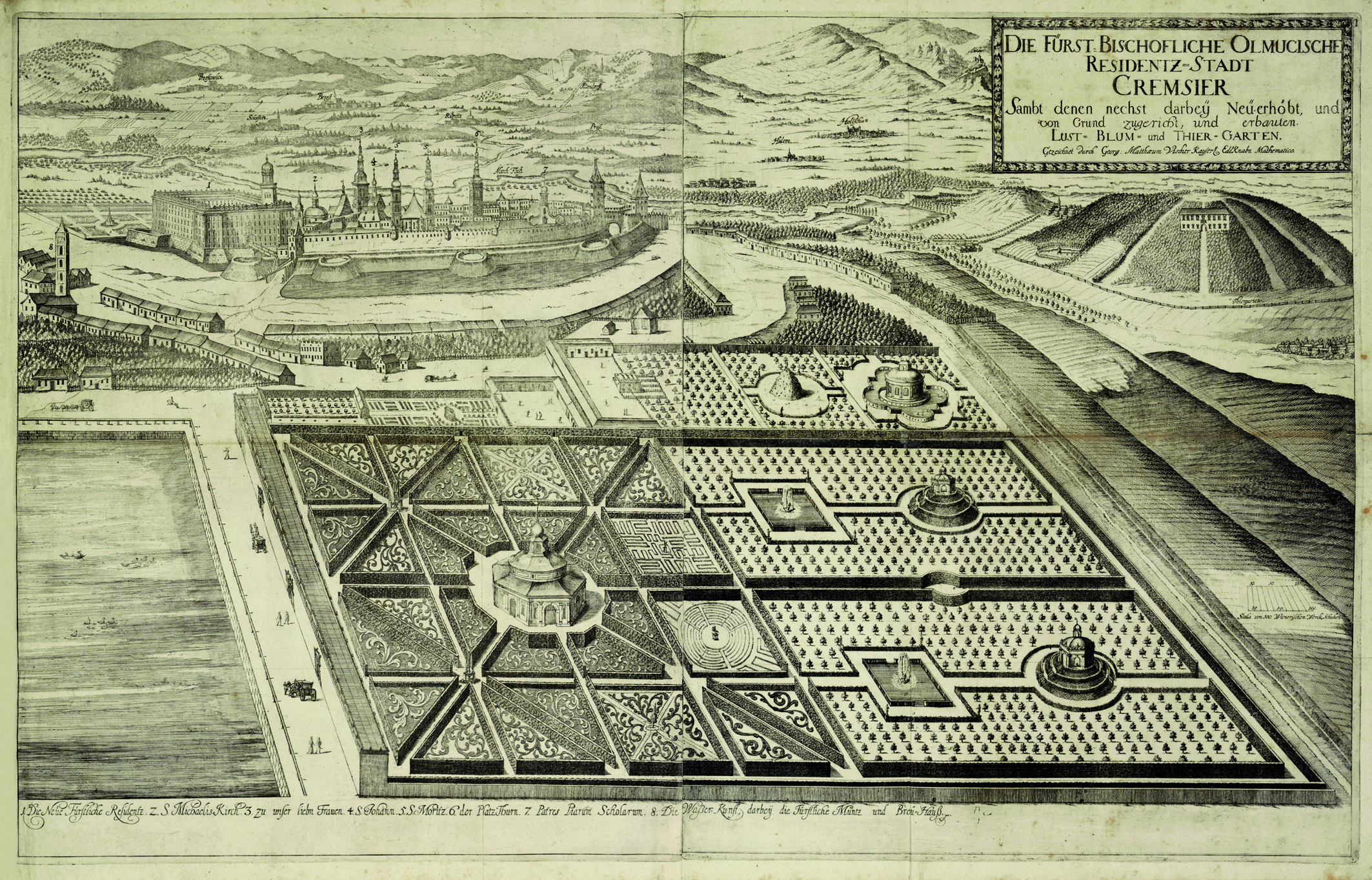
A general view of the Flower Garden and the town of Kroměříž in an engraving by Justus van den Nypoort from 1691.
Chronological development of the garden
1666 purchase of land for the establishment of the garden.
1667–1668 construction of the central pavilion, the so-called Rotunda, according to the design of Giovanni Pietro Tencalla.
1669–1675 interior decoration of the central pavilion took place. The interior of the building was conceived as an artificial cave with many water features. The stucco decoration was carried out by a group of stucco artists led by Quirico Castelli. Paintings based on individual episodes of Ovid's Metamorphoses were carried out between 1673–1675 by Giovanni Giacomo Tencalla (1644–after 1690). The sculptural decoration was created by Michael Mandík (around 1640–1694).
1668 the planting of green walls in the garden began from hornbeam seedlings dug up in the surrounding bishop's forests.
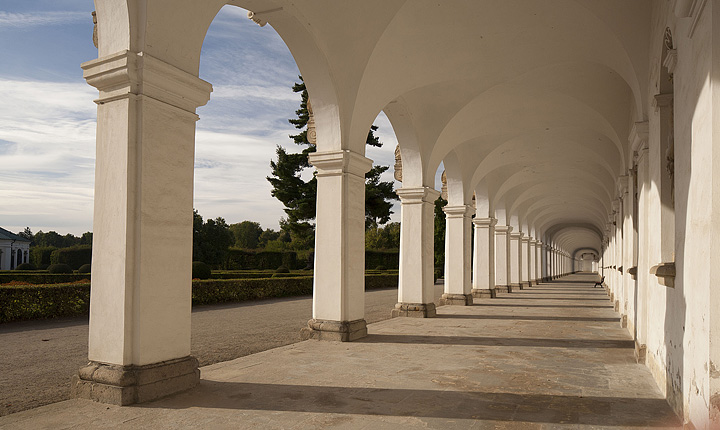
1675 construction of the arcade gallery according to the design of Giovanni Pietro Tencalla was completed. It measures 244 meters and fulfills several functions in the composition of the garden. First of all, it was an entrance building that partially replaced the missing building of the noble residence in the composition of the garden, and at the same time it was conceived as a gallery of sculptures. The set of forty-four statues, 22 female and 22 male, depicting mythological and historical figures of ancient times was carved according to engravings depicting important originals of ancient sculptures collected in Rome. The side walls of the colonnade were decorated with the Neptune and Venus fountains, of which, however, only the remains of the stucco decoration have survived. The bulk of the sculptures were made by the sculptor Michael Mandík (around 1640–1694).
1675 completion of the main works in the garden, minor modifications were also carried out in the following years.
1686 establishment of a fund (foundation) for the maintenance of the garden.
1691 publication of a graphic album, which captured the most impressive parts of the Flower Garden in thirty-five engravings, including two views of the city of Kroměříž and the chateau with the Castle garden and a portrait of Bishop Charles. It was prepared by the draftsman Georg Matthias Vischer (1628–1696) and the graphic artist Justus van den Nypoort (1645/1649 – after 1698).
1695 death of Bishop Charles II. of Lichtenstein-Castelkorn
1711–1738 episcopate of Bishop Wolfgang Hannibal of Schrattenbach meant a new flourishing of the garden, a number of repairs were carried out.
1714 expansion of the garden and construction of a brick orangery.
In 1723, an order for flower bulbs from Holland was successfully processed.
While efforts to maintain the original form and purpose of the Flower Garden continued in the first half of the 18th century, from the second half of the century, economic and cultivation facilities for the castle and the developing Castle Garden were purposefully built there. Preserved plans and reports from the turn of the 18th and 19th centuries document the establishment of greenhouses and other buildings for growing plants. The garden contained fruit orchards, vegetable beds and buildings for wintering hundreds of citrus plants, as well as fig and pineapple trees.
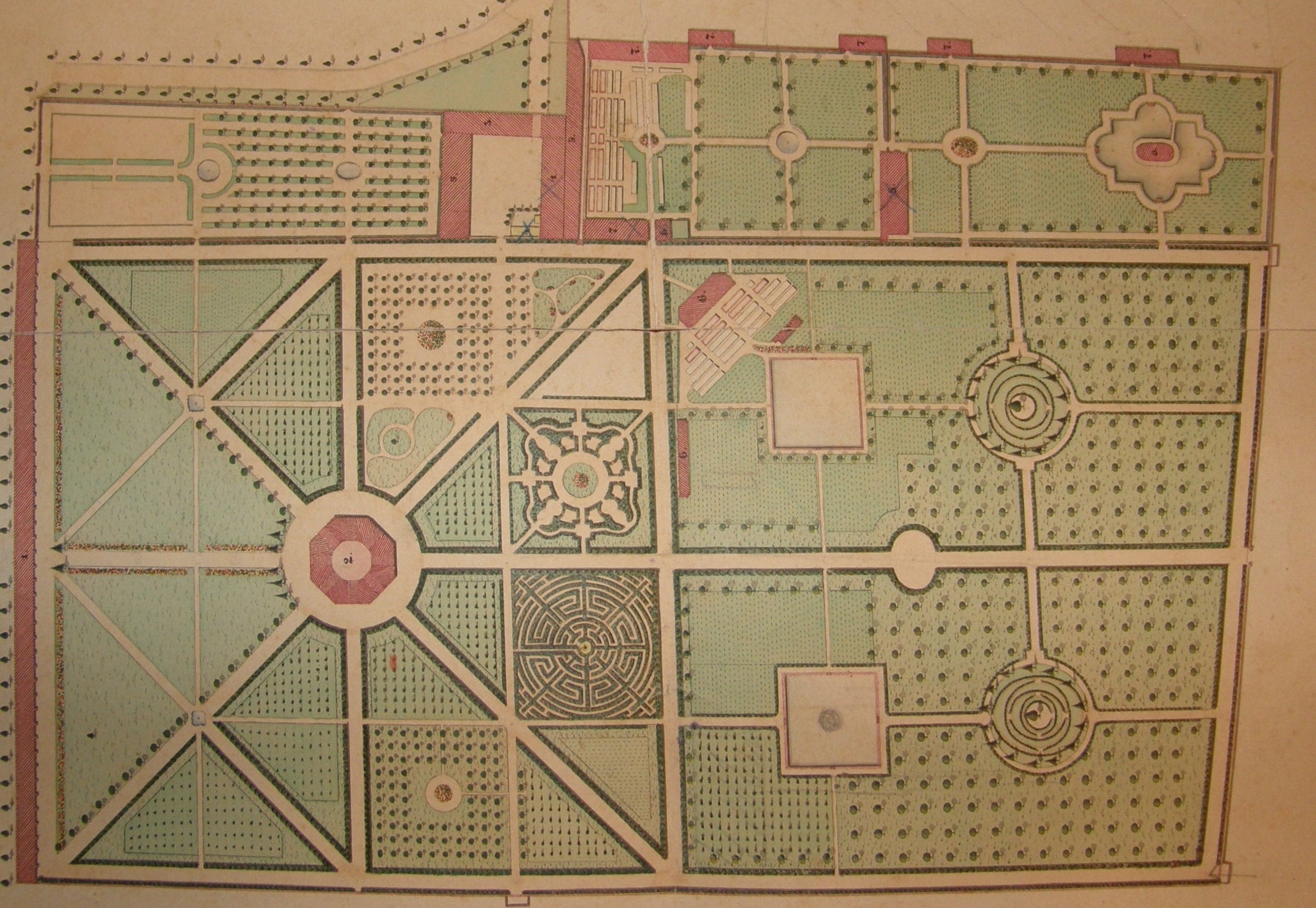
A plan of the Flower Garden from around the mid-19th century shows a number of structures for growing plants – orangery, greenhouses, fig tree house, and numerous hotbeds.
1837–1853 the episcopate of Archbishop Maximilian Josef Sommerau-Beckh brought significant changes to the garden, and the garden was opened to the public.
1838 a new water supply system was put into operation, supplying the town, the chateau and the Castle garden and Flower garden d with water from wells on Barbořina Hill and from Popovický brook.
1840s a new representative entrance to the garden was built in the place of the garden's maintenance facilities. According to the designs of the architect Anton Arche (1793–1851), an entrance honorary courtyard was created, delimited by a two-story house for gardeners with an arcaded facade and two greenhouses. The original orangery was replaced by the Large Greenhouse, supplemented on the opposite side of the courtyard by a smaller Palm Greenhouse.
1845 the central garden pavilion received a new roof according to the design of Anton Arche.
1853–1892 The episcopate of Archbishop Bedřich of Fürstenberg meant the opening of the Flower Garden to the public. A number of cultural and social events were held there. Among other things, the First Congress of Moravian Beekeepers, held on 26 and 27 August 1862 in the Great Greenhouse. In the following years, the tradition of organizing economic and industrial exhibitions in the Flower Garden became established, initiated by the Farmstead Unity of Záhlinice-Kvasice.
1893–1904 The episcopate of Archbishop Theodor Kohn saw a fundamental renovation of the central garden pavilion, the so-called Rotunda. The Archbishop decided to establish an archdiocesan museum in the building. Most of the original entrances were walled up, water locks including fountains were removed, a new floor was laid, an entrance risalit was built, etc. The Archbishop's emblem – a boat with a five-pointed star – appeared in many places in the building.
1904–1915 episcopate of Archbishop Francis of Sales Cardinal Bauer the garden was reopened for exhibitions and folk festivals. The highlight of which was the Jubilee Agriculture and Industrial Exhibition.
1908 the largest exhibition was held in the garden from 28 June to 1 September 1908 to celebrate the sixtieth anniversary of the reign of Emperor Francis Joseph I (1848–1916). Its protector, heir to the throne Francis Ferdinand d’Este (1863–1914), visited the Flower Garden on 26 July and during the duration of the exhibition another 165,000 people passed through it.
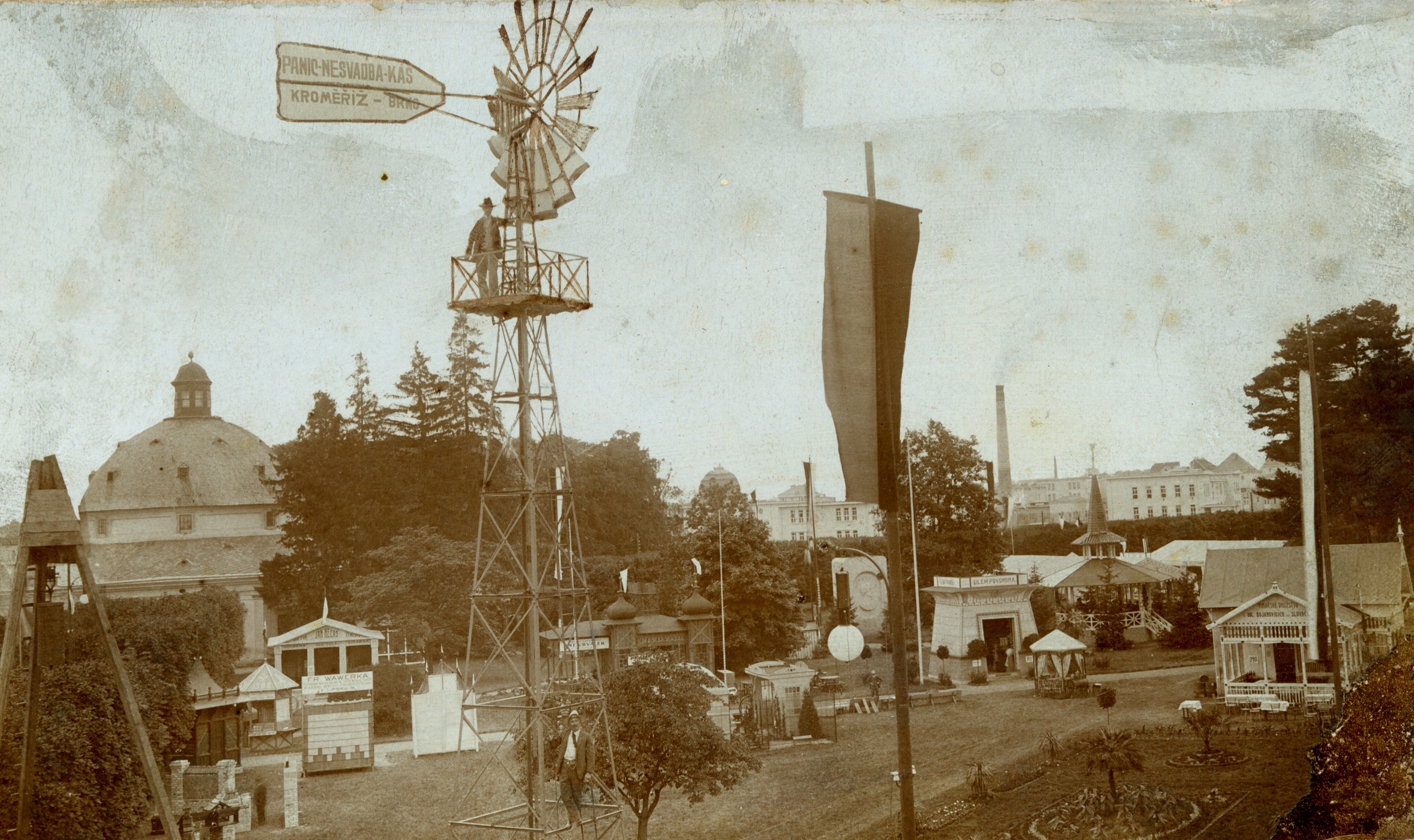
The Flower Garden during the Economic and Industrial Exhibition in 1908.
1908 Foucault’s pendulum was installed in the Rotunda, a device for demonstrating the Earth’s rotation, acquired on the initiative of the Kroměříž grammar school professor, physicist and astronomer František Nábělek (1852–1915).
The tradition of organizing exhibitions and social events was renewed even after the establishment of an independent republic, and similarly large exhibitions, such as the one in 1908, were held in the garden in 1925 and 1948.
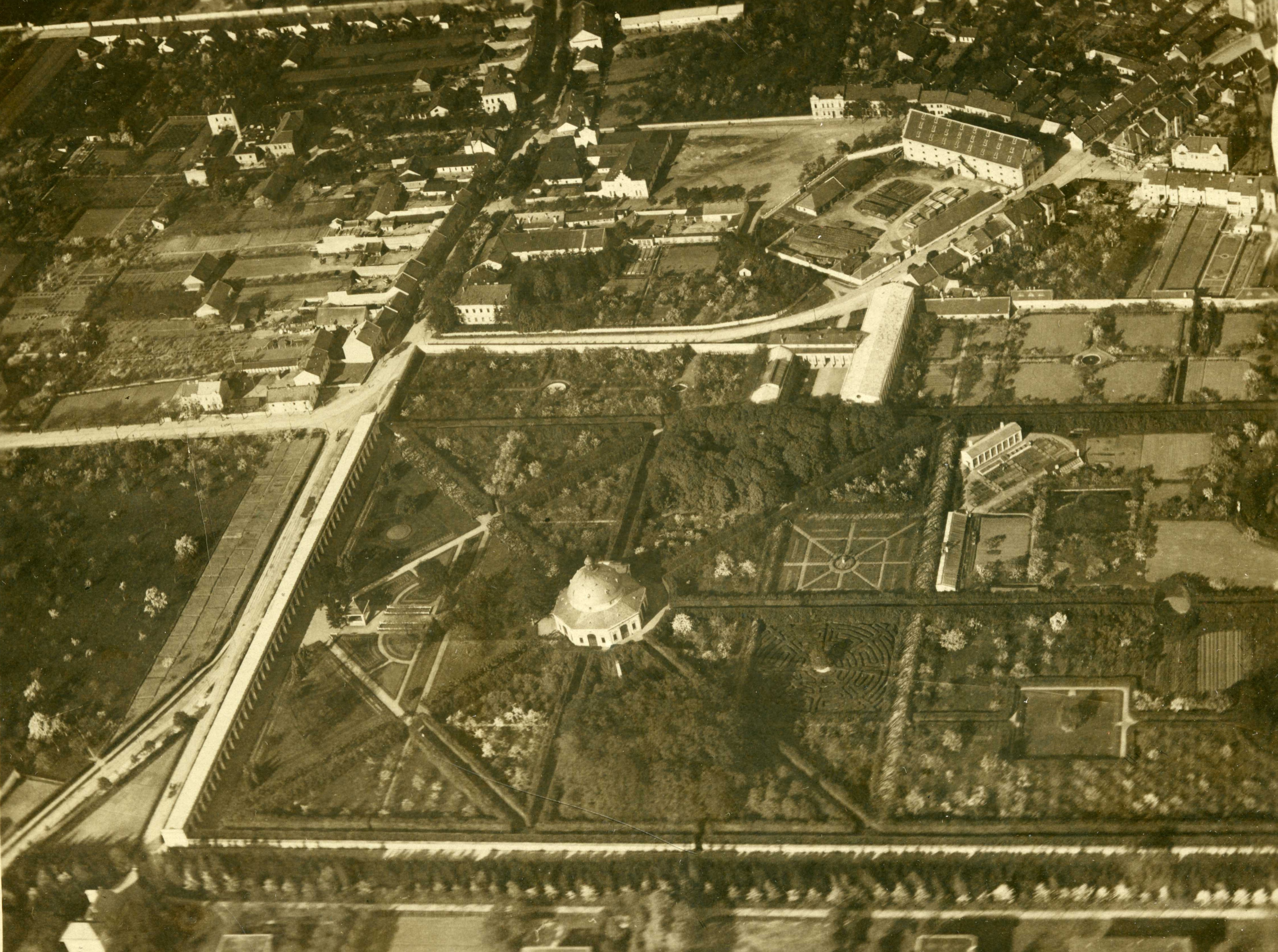
The Flower Garden and its surroundings in an aerial photograph from 1925, after the exhibition ended.
1949 The Flower Garden became state property.
In 1949, the Czech architect Pavel Janák (1882–1956), known, among other things, for his work in the Prague Castle area, was approached. He was given the task of creating a proposal for the restoration of the Flower Garden. The flower beds in front of the colonnade (the so-called Janák parterre) designed by him are planted every year with 50,000 annual plants grown in a greenhouse right in the Flower Garden.
1954 The Triton Fountain in the garden is set with four allegories of industry and agriculture conceived in the spirit of socialist realism by the sculptor Zdeněk Kovář (1917–2004).
1958 the garden became an immovable cultural monument.
1962–1963 preparation of the next stage of the garden's restoration by architects Dušan Riedl (1925–2015) and Josef Němec (1928–2021) from the State Institute for the Reconstruction of Monumental Towns and Buildings. The project was partially implemented in the following two decades.
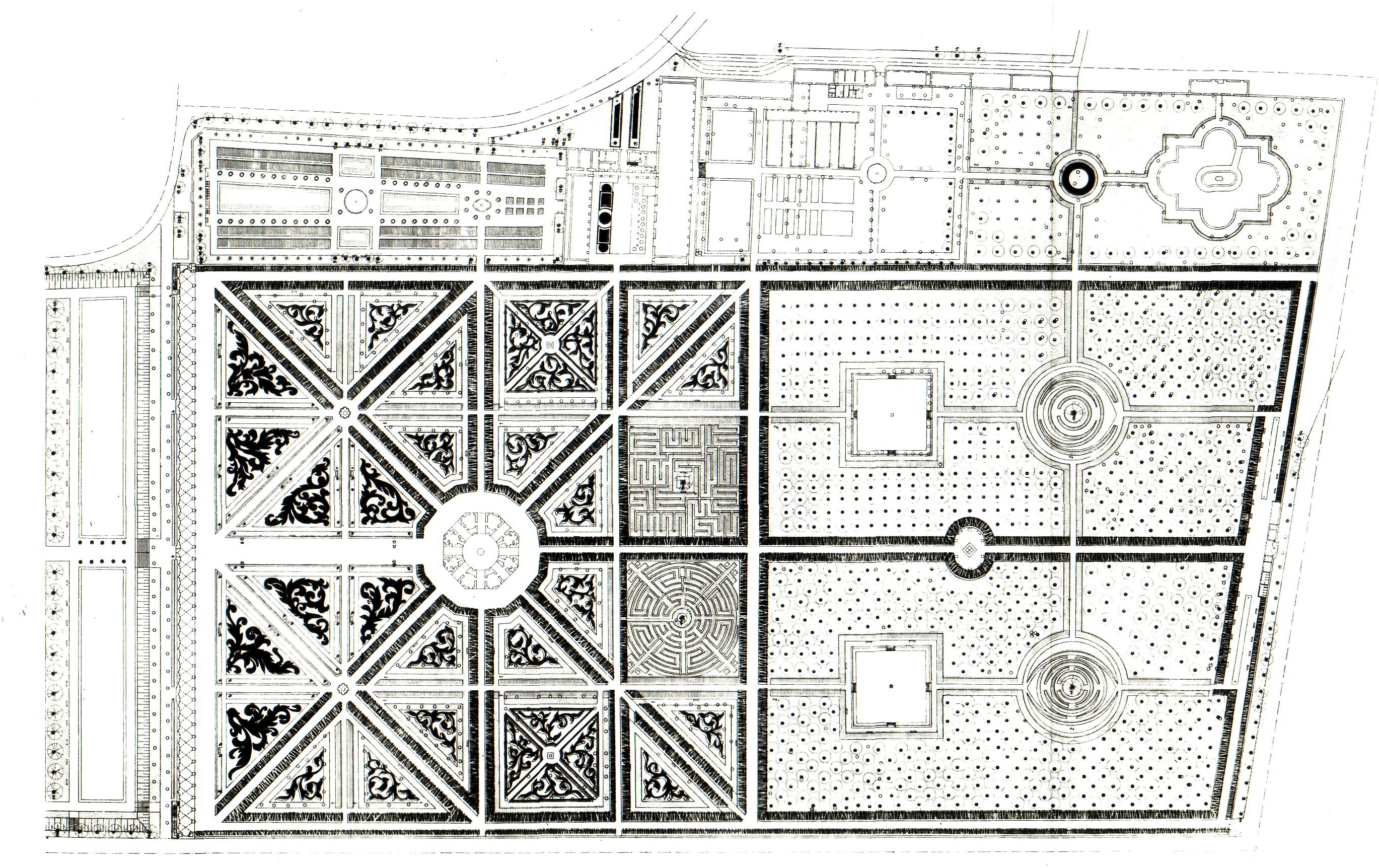
Project for the renovation of the Flower Garden from 1963.
1995 the garden became part of the national cultural monument "Kroměříž Castle with the Flower and Under-Castle Gardens" but without the Max's Court area.
1998 on 2.12.1998 the gardens with the castle in Kroměříž were inscribed on the UNESCO World Cultural and Natural Heritage List.
2000–2012 restoration of stone mosaics in the central garden pavilion, the so-called Rotunda, by Mgr. Jindřich Plotica (1957).
2008–2015, the last stage of the Flower Garden renovation took place as part of the National Centre for Garden Culture in Kroměříž (NCZK) project, co-financed by the European Union. The implementation phase of the project consisted of a model renovation of a significant part of the Flower Garden – the Dutch, Orange and Educational Gardens, Rabbit Hill, birdhouse, Trout Ponds, the Honorary Courtyard, gardening and high shaped walls. The general designer of the renovation was the architectural office Architekti D.R.N.H. in cooperation with garden architects doc. Ing. arch. Dr. Otakar Kuča, CSc., Ing. Zdeněk Sendler and Atelier Krejčiříkovi.
Author: Ing. Lenka Křesadlová, Ph.D
Interactive map
This interactive map will take you to the most interesting spots in the Gardens and Castle of Kroměříž. Through 46 interactive points, you can explore places that, with their richness, preservation, and integrity, form a unique world heritage site.
Open the interactive mapThe values for which the monument was selected and what this means for it today
The UNESCO World Heritage List includes only those monuments whose exceptional world value has been recognised based on international expert assessment. These monuments stand out because they represent the cultural and natural wealth of our planet, to the extent that they are valuable not only for the place or country where they are located, but also for all of humanity. The assessment of values must be understandable and transparent for both professionals and the general public, and therefore it is essential that each of these monuments meets the basic principles contained in the Implementing Guidelines to the World Heritage Convention. This means that it must correspond to at least one of the ten general selection criteria. At the same time, it must be documented that it meets the conditions of integrity (wholeness) and authenticity and must have an adequate system of protection and management to ensure its future. The Gardens and Castle in Kroměříž. have been among these World Heritage sites since 1998.
OUTSTANDING UNIVERSAL VALUE
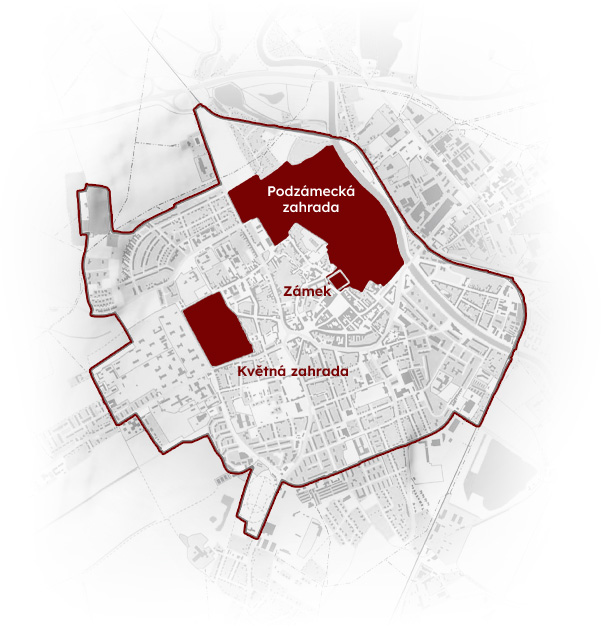
Brief synthesis The ensemble formed by the archiepiscopal castle, an adjacent garden (Podzámecká zahrada) and a pleasure garden (Květná zahrada) situated nearby, is located in the historic centre of the town of Kroměříž, in the Zlín region of the Czech Republic.
The “Gardens and Castle at Kroměříž” illustrate a type of early Baroque architectural ensemble which introduced to Central Europe, ravaged by war, high architectural values of Italian origin, linked with high-quality sculpture, paintings, and applied arts and enhanced by the acme of garden design in which the technological potential of the use of water was developed with virtuosity. The Castle Garden demonstrates, in an extraordinary way, the creative affinity between the garden art of Central Europe and broader European trends in the design of landscape parks. The Pleasure Garden influenced Moravian garden design, whilst the influence of the Castle spread further, to the Danube region. Description of values, criteria and attributes HERE, in a publication of the National Heritage Institute, from 2022.
Documents
Management Plan for the Gardens and Castle in Kroměříž
The Management Plan (hereinafter referred to as the MP) is an effective tool for the conceptual and professional care of a property of outstanding universal value, inscribed on the UNESCO World Heritage List, the Gardens and Castle in Kroměříž. It was prepared in 2009 and updated in 2020. The basic prerequisite for its implementation is the involvement and interest of the owners, relevant professional departments, representatives of the city of Kroměříž and the UNESCO Club in Kroměříž. Its update began in 2025.
Download as PDFSteering Group and Site Manager for the Gardens and Castle in Kroměříž
The Steering Group of the Gardens and Castle in Kroměříž – UNESCO World Cultural and Natural Heritage Sites consists of authorized representatives of the decisive owners of the site (Archbishopric of Olomouc, Czech Republic - National Institute of Heritage, Zlín Region), representatives of local and regional self-government and representatives of civil society, or other entities. It currently has 13 members, including the site manager.
Download as PDFNews, projects, and publications

Advent na zámku 2026
5.12.2026 - 20.12.2026
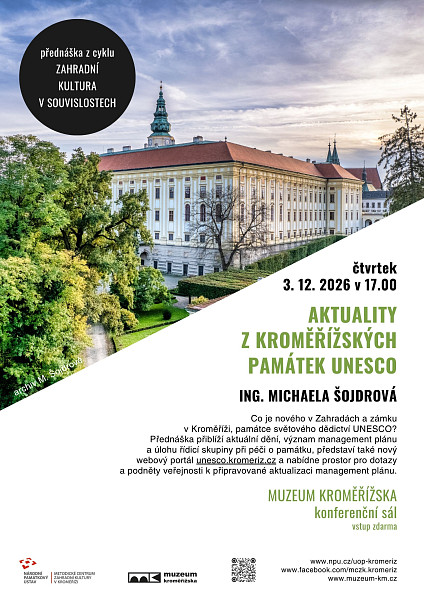
Aktuality z Kroměřížských památek UNESCO
3.12.2026
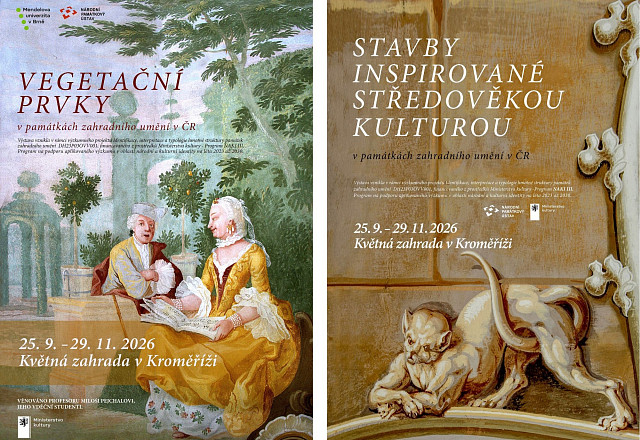
Vegetační prvky v památkách zahradního umění
25.9.2026 - 29.11.2026
Projects
Amethyst Grottoes Archbishop's Chateau in Kroměříž
ametystovegrotty.czWorld Heritage Journeys
The objective of the project is to inspire people to experience Europe´s unique cultural heritage through thematic trans –Europe itineraries.
 visitworldheritage.com
Visitor information


Site owners
The Archbishop's Palace and the Castle Garden are owned by the Roman Catholic Church, represented by the Archbishopric of Olomouc. The Castle Garden includes the Maximilian's Court, which is owned by the Zlín Region. The Garden is owned by the state, represented by the organisation founded by it - the National Monument Institute.


Cooperating organizations
Klub UNESCO Kroměříž
The UNESCO Kroměříž Club was founded on September 9, 1991 by representatives of the social, cultural and political life of the city - Kroměříž patriots with the aim of fulfilling the program of the United Nations Educational, Scientific and Cultural Organization (UNESCO).
 unesco-kromeriz.cz
Muzeum umění Olomouc v Kroměříži
The Olomouc Museum of Art, through the Archdiocesan Museum Kroměříž, manages the collection fund of the Olomouc Archbishopric at the Archbishop's Castle in Kroměříž. It includes paintings, sculptures, drawings, graphics, coins, medals, arts and crafts, a historical library and a music archive. Some of the collections have the character of library funds - manuscripts, intaglios, old prints, music manuscripts and old music prints.
 sbirky.muo.cz


Photo gallery
The project was implemented by the UNESCO Club Kroměříž with financial support from the Ministry of Culture.